There’s chatter that Canada may soften or even drop its sector-wide oil & gas emissions cap as part of a new climate plan. Ottawa is already working with Alberta oil companies on the details . Whether that happens or not, one reality won’t change for field teams in Western Canada: your daily compliance is driven by provincial rules - especially Alberta’s Directive 060 for flaring, incinerating, and venting.
Federal headlines vs. provincial obligations
- Federal policy shapes long-term strategy, investor sentiment, and ESG narratives.
- Provincial rules (e.g., AER Directive 060 in AB; SK/BC guidance on flaring/venting/fugitives) set the operational requirements you must meet on pad - today, tomorrow, and next quarter.
Even if Ottawa adjusts national targets, operators still face scrutiny from regulators, partners, insurers, and communities on how they handle vapours and hydrocarbons in real time.
What stays firmly in focus on site
- Control vapours: capture, route, and destroy vapours instead of venting.
- Flare safely: correct stack sizing; reliable pilots/ignitors; remove liquids before the flame.
- Measure & document: inspections, logs, and reporting to prove compliance.
- Choose equipment built for compliance: sealed systems & positive-pressure designs reduce leaks and simplify approvals.
Where OSY Rentals helps (fast, compliant, turnkey)
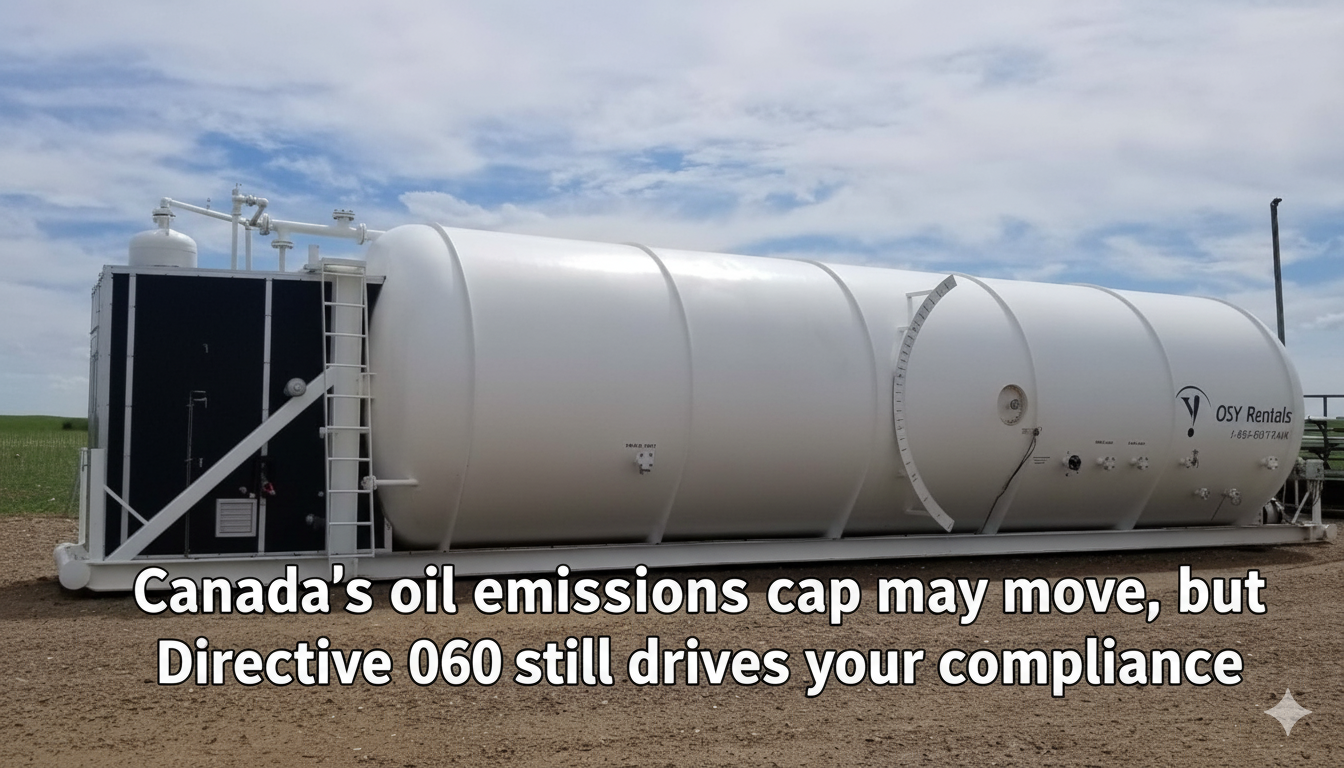
- Vapour-Tight Tank Packages (Positive-Pressure) - treated as process vessels in Canada (vs. standard “tanks”), which often eliminates secondary containment requirements while improving fugitive-emission control.
- Separators - improve measurement accuracy and ensure only clean gas reaches your flare/incinerator.
- Flare Stacks - portable, engineered systems with reliable ignition and accessories to simplify approvals.
- Flare Knockout Drums - remove entrained liquids to protect stacks, reduce smoke, and improve combustion.
Practical checklist for Alberta projects
- Select a sealed package (vapour-tight tank + separator + KO drum + flare) to minimize venting.
- Confirm sizing & limits (gas rates, liquids load, H2S, dispersion assumptions).
- Verify pilots/ignition & shutdowns (proof-of-flame, ESD tie-ins, ignition readiness).
- Prove liquids management (KO drum capacity, drain routing, handling plan).
- Document compliance (startup checklist, inspection log, emissions records).
- Plan for upset (temporary vapor control provisions, spare parts, swap-outs).
Bottom line
Federal policy may move, but Directive 060 and provincial guidance still drive your daily compliance. If you want fewer headaches during audits and fewer delays in approvals, use equipment that matches what regulators expect to see on site.
Note: This article reflects current public discussions and existing provincial frameworks. Always consult the latest AER/BC-ER/Ministry guidance and approvals for your specific site.
